Vlad Tenev Will Become CT’s Next Main Character
Every crypto cycle produces a main character who turns attention into capital flows. Elon had tweets, Murad had frameworks, Saylor had balance sheets. Vlad Tenev may be the first to hold the entire value chain at once attention, distribution, infrastructure, and tokenized assets.

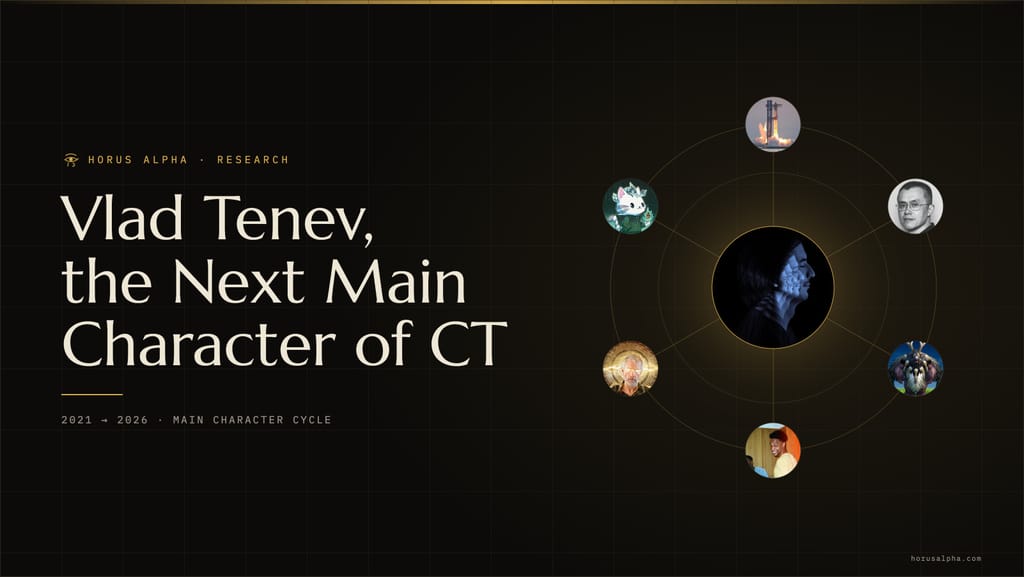
In every crypto cycle, the market tends to produce a figure who attracts most of investors’ attention.
They do not necessarily build the best product or have the largest following. They become a main character because they emerge when a new narrative is taking shape, represent that narrative, and can turn attention on Crypto Twitter into real capital flows.
- In 2021, Elon Musk could move Bitcoin and Dogecoin with only a few tweets.
- In 2022, Do Kwon, Sam Bankman-Fried, and CZ became the center of attention as Terra and FTX collapsed in sequence.
- In 2023, Vitalik Buterin became the face of an Ethereum-focused airdrop cycle, as Layer 2 airdrops, the LST wars, and restaking shaped much of the narrative on CT.
- By 2024, Ansem and Murad shaped how CT viewed memecoins as an asset class and a distinct culture.
- In 2025, Michael Saylor and Tom Lee represented the institutional adoption wave that pushed BTC and ETH to new all-time highs, with Tom Lee likely accounting for a large share of the buying pressure. Meanwhile, Jeff Yan turned Hyperliquid into the center of the onchain perpetual trading revival and opened an entirely new trend of airdrop hunting through perps.
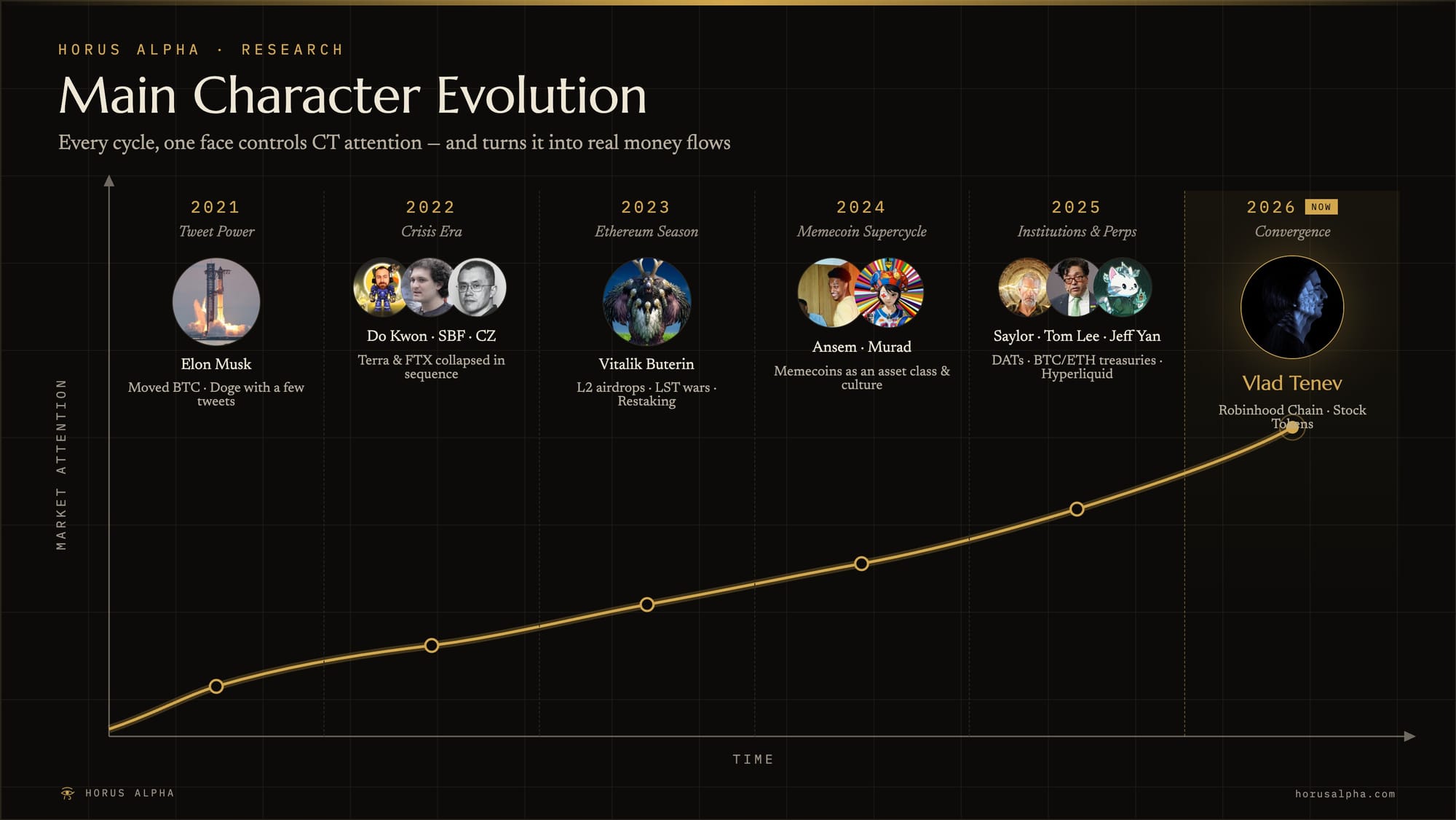
The current cycle may be creating a new main character, and that person is Vlad Tenev. The key point is not only that Vlad is appearing more frequently on CT. Behind every post sits Robinhood, a major distribution layer with existing users, capital, assets, and trading infrastructure.
Robinhood Chain could shorten the distance between a tweet and an onchain trade. With such a large user base, Vlad’s influence could extend far beyond ordinary social engagement.
What Is a Main Character?
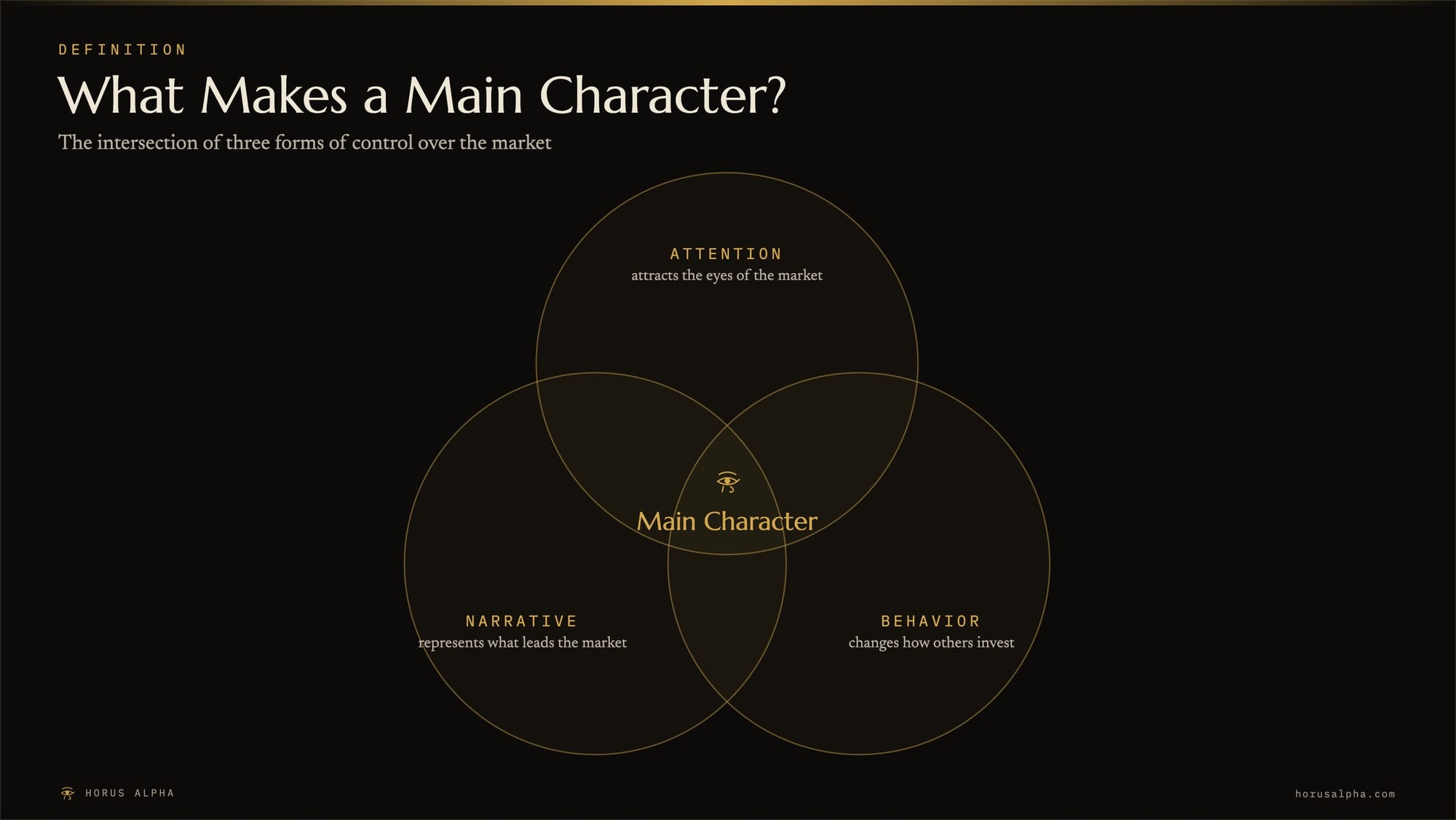
A CT main character usually emerges at the intersection of three factors.
- They must be able to attract attention.
- They must represent a narrative that is leading the market.
- They must be able to influence how others invest.
Looking back at previous cycles, each figure controlled a different form of attention.
2021 and the Power of a Single Tweet
Elon Musk is the clearest example of the ability to turn attention into market movement. His posts about Bitcoin, Dogecoin, or Floki did not require a complete marketing campaign. CT amplified the message, traders reacted, and liquidity shifted immediately through buy and sell orders.
SBF was also a major figure during this period, with Solana serving as a key catalyst. FTX had financial strength and political connections, which gave it significant influence across the Solana ecosystem. However, when it came to moving the entire market with a single post, Elon was still the clearer main character. He also played a major role in bringing the concept of memecoins into the spotlight.
2022 and Main Characters Created by Crisis
The first half of 2022 belonged to Do Kwon and Terra Luna. The Ethereum Killer wave emerged through new ideas around design, philosophy, and improved DeFi mechanisms. Before Terra collapsed, Do Kwon built an image as a founder willing to argue publicly, make multi-million-dollar bets, and attack anyone who questioned UST. When the system could no longer maintain its peg, all of CT followed every development related to Luna.
By the end of the year, the collapse of FTX brought SBF and CZ to the center of the market. Unlike Elon, these figures did not become main characters by opening a growth narrative. They became the focus because they represented systemic risk, power conflicts, and the collapse of trust across the industry.
2023 and Ethereum Becomes the Center of the Market
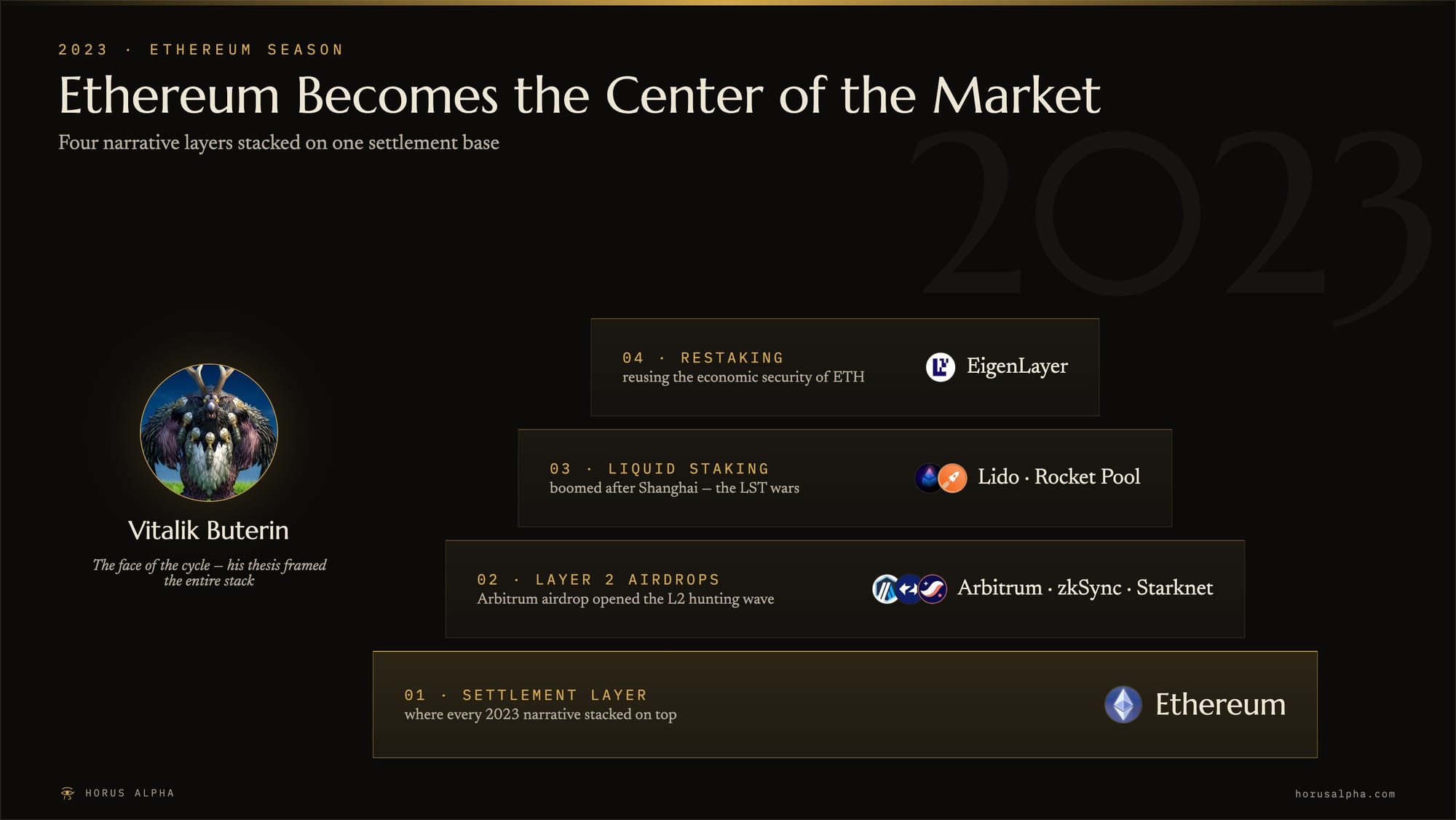
There was no single figure in 2023 who controlled CT in the same way that Elon or SBF had. However, if one representative had to be chosen, Vitalik Buterin remained the most reasonable option. This was a period when Ethereum-focused narratives expanded through layers of infrastructure built on top of Ethereum.
- Arbitrum carried out its airdrop, which triggered a major wave of Layer 2 airdrop hunting. At that point, founders and senior executives from these projects became key figures for part of the user base to monitor.
- The market began following zkSync, Starknet, and many other Layer 2 projects that Vitalik had invested in.
- Liquid staking expanded rapidly after Shanghai, leading to greater competition between Lido, Rocket Pool, and new LSD models.
- Restaking also began attracting attention as EigenLayer introduced the possibility of reusing ETH economic security.
Vitalik did not directly create all of these products. However, his arguments around allowing Layer 2s to handle scaling while Ethereum became the settlement layer made Layer 2s more heavily promoted than ever.
2024 and the Memecoin Supercycle
Ansem was one of the most influential figures in bringing Solana memecoins to the broader crypto market. His ability to identify tokens early and bring them into the wider conversation meant that each post from Ansem could draw smart money and liquidity toward a specific token.
Murad took over part of this role in the second half of 2024. His Memecoin Supercycle presentation at Token2049 helped turn memecoins from a series of random trades into a structured thesis.
He created significant attention around his own bags and also developed a set of standards for memecoins worth holding, including
- Is the memecoin’s bubble map sufficiently decentralized?
- Has the memecoin gone through stress tests, including multiple 80% declines?
- Is its community compelling enough?
- Are the holders willing to work for their bags?
Ansem had a strong influence on token discovery, while Murad offered a broader argument and framework for how memecoins attract capital. Together, they became the main characters of a period when the attention economy was more visible than ever.
2025 and the Divide Between Institutions and Onchain Trading
2025, the final year before entering a new cycle, did not have one specific narrative. Retail capital was largely split between debates around tech coins and memecoins.
In that environment, the market needed credible individuals who could bring capital into BTC and ETH. Michael Saylor and Tom Lee represented the institutional adoption branch, Bitcoin treasuries, and capital from traditional markets.
By raising capital and deploying billions of dollars into BTC and ETH, they helped trigger the DAT movement across Wall Street. At that point, almost every coin with a DAT rose quickly. Attention no longer concentrated on a specific project ecosystem, as traders waited for companies to announce new holdings.
At the same time, Jeff Yan represented the rise of Hyperliquid and onchain perpetual trading. What these figures had in common was that the products or strategies they represented became narratives in their own right.
- Saylor did not need to shill individual tokens. Every additional Bitcoin purchase by Strategy gave the market more data to debate corporate treasuries and the use of traditional capital markets to accumulate BTC.
- Jeff Yan also did not operate like a CT influencer. Hyperliquid became a narrative through its product, liquidity, airdrop, and ability to prove that an onchain venue could compete with centralized exchanges.
What Does Vlad Tenev Bring to the Next Phase?
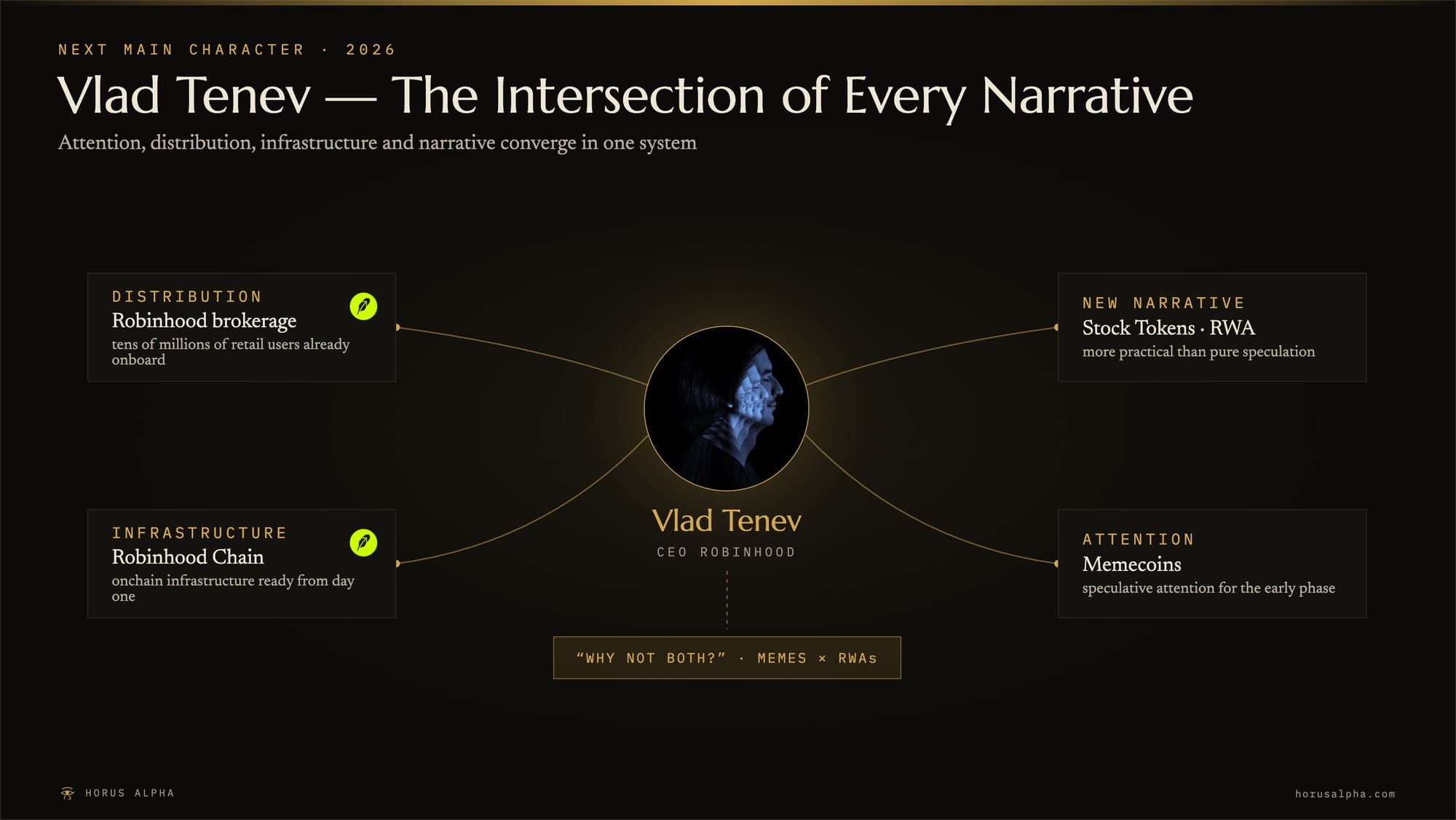
Vlad Tenev differs from most previous main characters because he sits at the intersection of several narratives.
- Robinhood has brokerage distribution.
- Robinhood Chain has onchain infrastructure.
- Stock Tokens offer a newer and more practical narrative than pure speculation around memecoins or AI agent coins.
- Memecoins bring speculative attention to the network’s early phase.
Vlad has a system that can connect these elements into a unified whole and make them work together effectively. This is why Vlad’s post titled “Why not both?” featuring two wolves representing memes and RWAs received a positive reaction from CT. It showed how the company’s leader understands crypto culture.
CT Wants Founders to Stand With Their Ecosystems
When Robinhood Chain launched, many people argued that memecoins becoming the network’s largest market so quickly showed that the ecosystem was moving in the wrong direction. However, this sequence may fit the way a new blockchain builds liquidity. Speculative activity brings traders, capital, and attention onto the chain first. Products with clearer utility can then develop in a market that already has users.
This was also the playbook that helped Solana expand. Memecoins made the ecosystem more active, created volume for DEXs, and attracted applications serving traders, while liquidity formed during the speculative phase continued to support other markets.
Vlad’s public support for memecoins therefore carries meaning beyond ordinary shilling on CT. He is helping Robinhood Chain maintain mindshare during its early stage, while showing the community that traders who create initial liquidity will not be treated as temporary users. If memes retain attention long enough for tokenized assets to expand their volume, Robinhood Chain could turn speculative activity into a bridge that moves users from brokerage products into DeFi.
The key metric to watch is the volume split between RWAs and memecoins. If tokenized stocks continue to gain market share over the coming months, Robinhood Chain could show that memes have fulfilled their role in starting liquidity rather than becoming the only active market on the chain. At that point, Robinhood would not simply be building another venue for memecoin trading. It could form a practical bridge between millions of brokerage users and onchain finance.
Why not both? pic.twitter.com/7rnarR8tgB
— Vlad Tenev (@vladtenev) July 17, 2026
The Gap Left by Base and BNB Chain
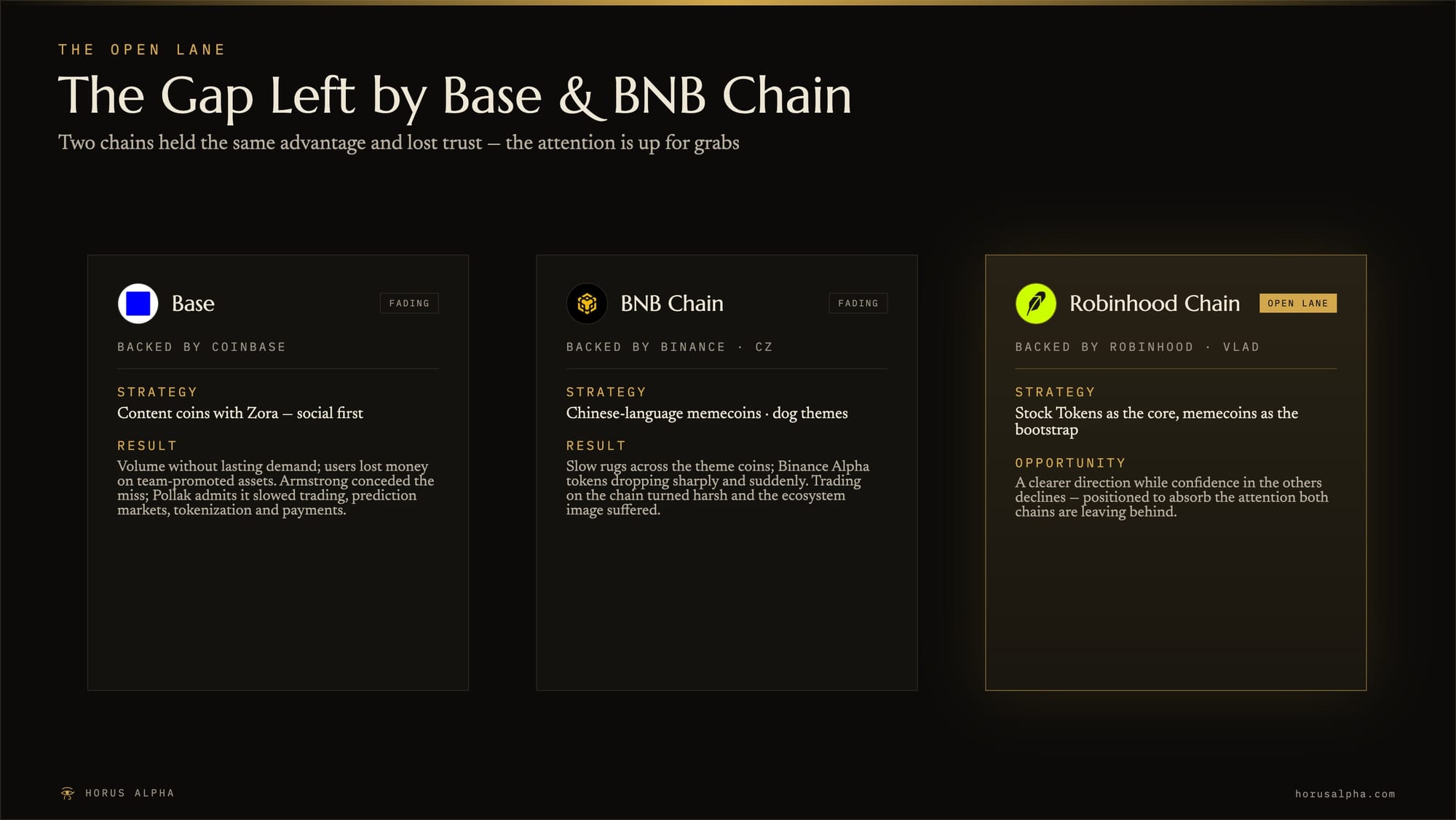
Base previously held a similar advantage through the Coinbase brand, a large user base, and fiat on-ramps. However, its strategy around content coins and Zora created large amounts of token activity and volume in a short period without maintaining demand. As a result, many users suffered losses from assets promoted by the ecosystem team.
In July 2026, Brian Armstrong acknowledged that content coins had not achieved the expected results, while Jesse Pollak argued that Base’s focus on social had slowed its progress in trading, prediction markets, tokenization, and payments.
Regarding the recent buzz around my profile picture changes and some feelings that the Base community isn’t being supported enough: I appreciate the feedback (even if tough to hear) and I realize you wouldn't take the time to respond unless you cared.
— Brian Armstrong (@brian_armstrong) July 20, 2026
It seems I wasn't clear…
As confidence in Base declined, Robinhood had an opportunity to attract some of this attention through a clearer direction. CZ and BNB Chain also had a relatively strong start, but BNB Chain has largely left the market with Chinese-language memecoins and dog-themed tokens that are slowly rugging. Tokens on Binance Alpha have also continued to decline sharply and suddenly, making trading on BNB Chain highly difficult and damaging the image of the broader ecosystem.
Tokenized Assets Are the Key Strategic Asset
Crypto capital rarely remains in one narrative forever. When returns from memecoins decline, capital often looks for a new asset class with a strong enough story to continue circulating. Tokenized assets could become one of the next destinations because they connect crypto liquidity directly with equities, private markets, commodities, and other financial assets.
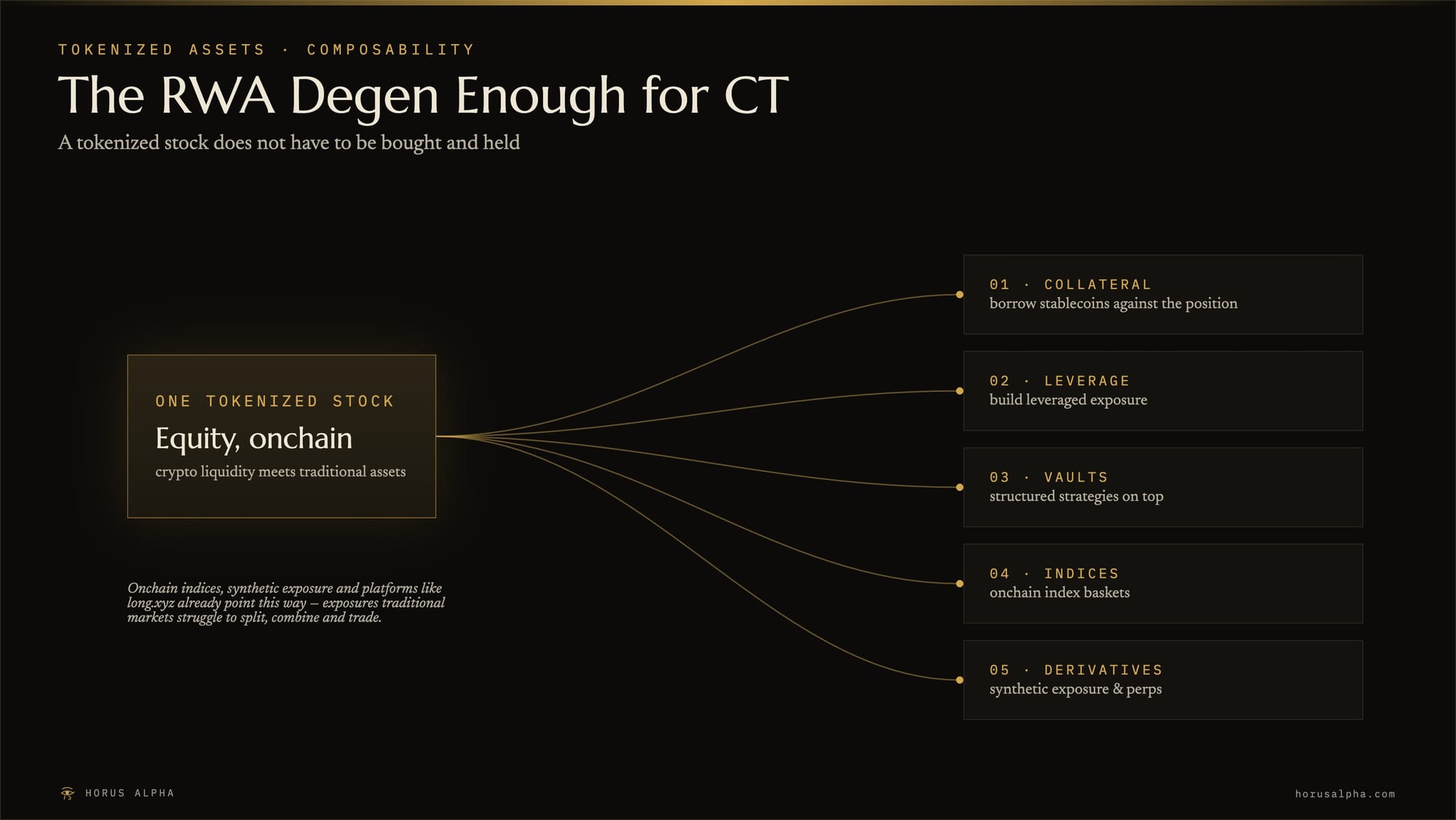
The key feature is composability, which few teams discuss enough. A tokenized stock does not have to be bought and held. It can become collateral for borrowing stablecoins, building leveraged positions, creating vaults, forming indices, or trading through derivatives products.
Models such as onchain indices, synthetic exposure, and platforms like long.xyz show that Robinhood Chain could develop in a direction that closely matches the needs of crypto-native traders.
Instead of bringing securities onto a blockchain and preserving the old brokerage experience, builders can separate, combine, and trade these exposures in ways that traditional markets struggle to support.
This is the version of RWA that is sufficiently degen for CT to care about. More accurately, it creates a new economic incentive for capital to move, rather than relying on the same incentive-driven approach used by many other ecosystems.
Distribution Is the Hardest Advantage to Replicate
Most blockchains have to spend token incentives to attract users. Robinhood already has a user base familiar with trading stocks, options, crypto, prediction markets, and higher-risk products. As a result, Robinhood Chain does not have to start entirely from zero.
Robinhood could selectively list certain native Robinhood Chain assets on its main application. This would offer several key advantages, and the playbook closely resembles BNB and Binance or Coinbase and Base.
- It would improve access for retail users.
- New liquidity could flow into listed tokens.
- Onchain traders would hunt for tokens that could be listed, creating economic activity for the network.
- Builders would then have stronger incentives to launch products on the chain.
A typical onchain project must find its own exchange listings, users, and liquidity. A project on Robinhood Chain could sit close to one of the largest retail distribution channels in financial markets. If it performs well, access to that liquidity becomes entirely possible.
Conclusion
Previous main characters usually controlled one part of the value chain.
- Elon controlled attention.
- Ansem influenced token discovery.
- Murad shaped narratives.
- Saylor connected Bitcoin with capital markets.
- Jeff Yan represented an onchain product that became a narrative in its own right.
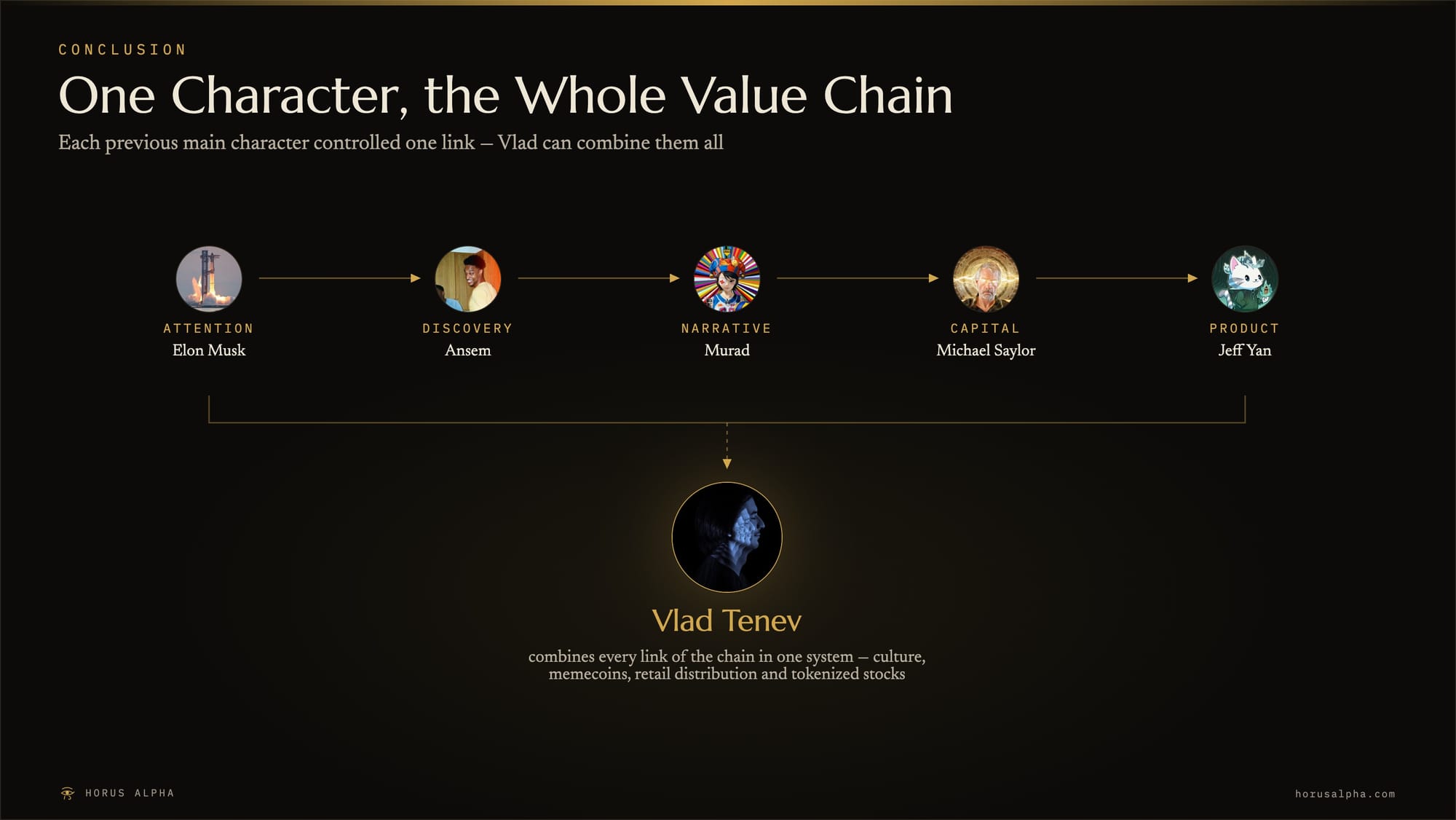
Vlad has the potential to combine all of these elements in one system. He understands CT’s speculative culture, is willing to publicly support memecoins, owns a major retail platform, and is building infrastructure around tokenized stocks.
In the future, every post from Vlad could be treated as a signal across CT, while traders take on the task of interpreting it. Memecoins will certainly play an important role, as long as Robinhood does not focus on them too heavily and overlook the need to capture longer-term trends.
Nothing here is financial advice. Always do your own research.