Think Backpack Is Just a Solana Perp Exchange? Think Again
Most people see Backpack as another Solana perp exchange. But its tokenized stocks, backed by real brokerage infrastructure, open a much larger market and could turn every stock narrative into an acquisition channel.

At first glance, most people would place Backpack in the same category as other crypto trading venues. Backpack has spot, perpetual futures, lending, unified margin, and a native token used for fee discounts. On the surface, this looks like the familiar formula of an exchange. However, that view misses many of the most important parts of Backpack’s strategy.
Tokenized stocks are the part most people tend to overlook on Backpack, and they are not the same as the tokenized stocks you usually see from other platforms on CT.
In the first month, the six tokenized securities issued by Backpack, including $SPCX, $MU, $SNDK, $DRAM, $BOT, and $SKHY, generated a total of $1.5B in volume, according to company-reported data. The most discussed example was BOT, whose volume on Solana on Sunday was higher than the volume of $BOT stock on Nasdaq the following Monday.
In this article, I will show that if you only look at Backpack as a simple exchange, you will miss the much larger upside of the product.
Backpack Is Not Just an Exchange
Backpack’s bio states that ambition quite directly.
Your neobrokerage, your exchange, your money.
Those three words correspond to four product layers being combined into the same account, with each layer solving a different part of the capital lifecycle.
- The trading layer includes spot, perpetuals, margin, lending, and borrowing. When Auto Lend is enabled, idle balances generate yield while still being counted toward margin, so users do not have to choose between keeping capital active and putting capital to work.
- The ownership layer is Backpack Securities. Instead of only adding an equity perp to expand the market list, Backpack brings users into brokerage infrastructure and creates a security entitlement before the asset is converted into token form. This layer provides the legal anchor and the redemption path back into the securities system.
- The distribution layer includes Backpack Wallet, Sunrise, and Solana. When a token is withdrawn from the exchange, it can appear in a wallet, aggregator, DEX, or lending protocol outside Backpack. At that point, the tokenized security is no longer just an internal balance, but an asset that can move across multiple applications.
- The payment layer includes direct USD wire with 1:1 USD to USDC conversion, which is already live, and Backpack Card, which is still in the coming soon stage.
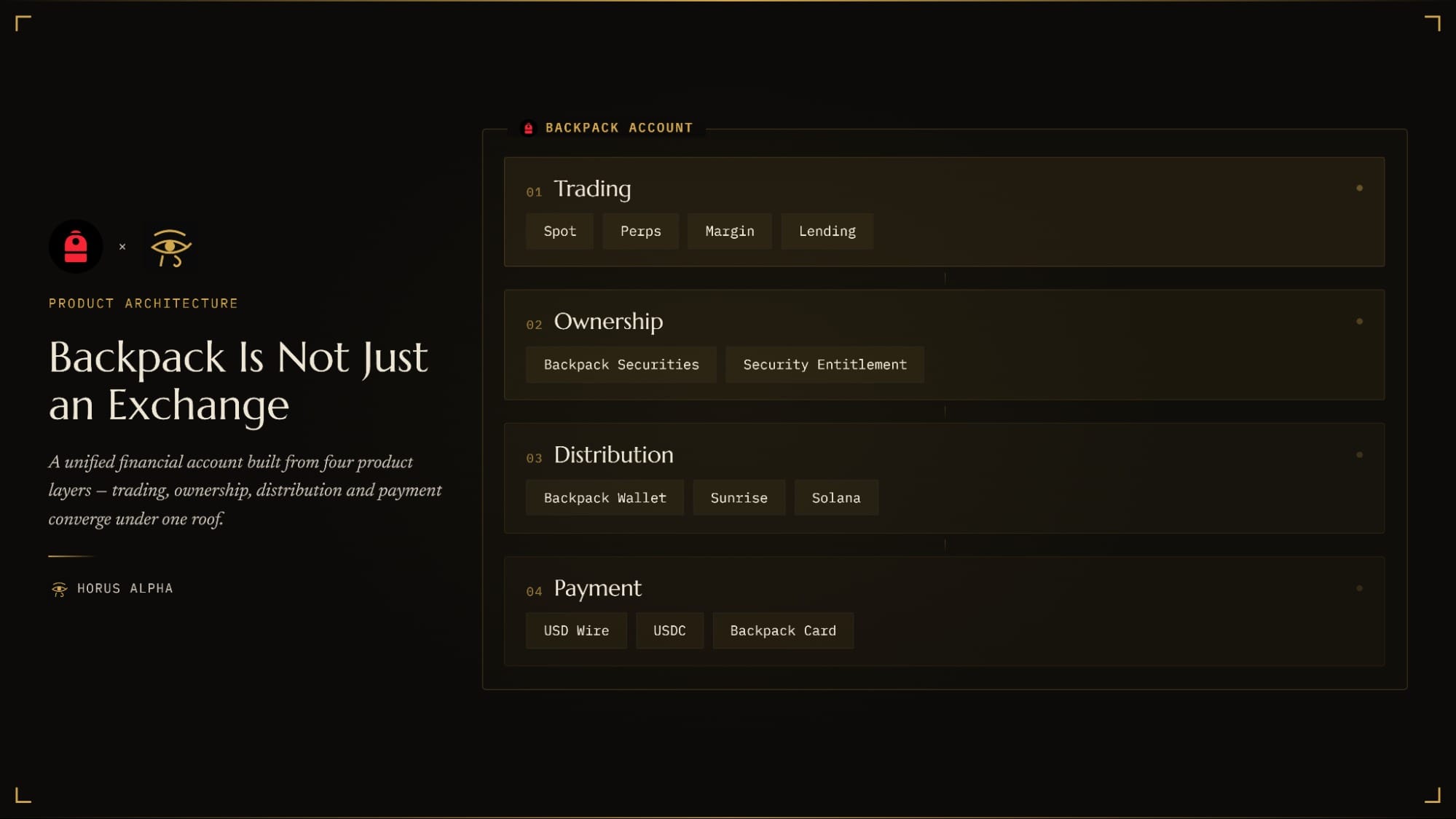
If all four layers work together, users can deposit USD or stablecoins, buy crypto and securities, use capital to trade or earn, withdraw assets to Solana, and then return to the same account to borrow, trade, or spend.
Beyond a closed loop, the thing that creates a long-term edge, and even a current edge, is the difference created by tokenized stocks. First, let’s look at the potential of tokenized stocks.
Tokenized Stocks Are No Longer a Side Market
Perp trading is a trillion-dollar market, which is also why this product category is extremely crowded. Hyperliquid, Lighter, Pacifica, Phoenix, and dozens of other venues are competing across the same product set, where advantage is measured in a few basis points of spread and a few dozen milliseconds of latency.
Tokenized stocks are a different game. The absolute scale is still much smaller, but the market is in a growth phase that perp markets moved past a long time ago, and the number of venues truly participating can still be counted on one hand.
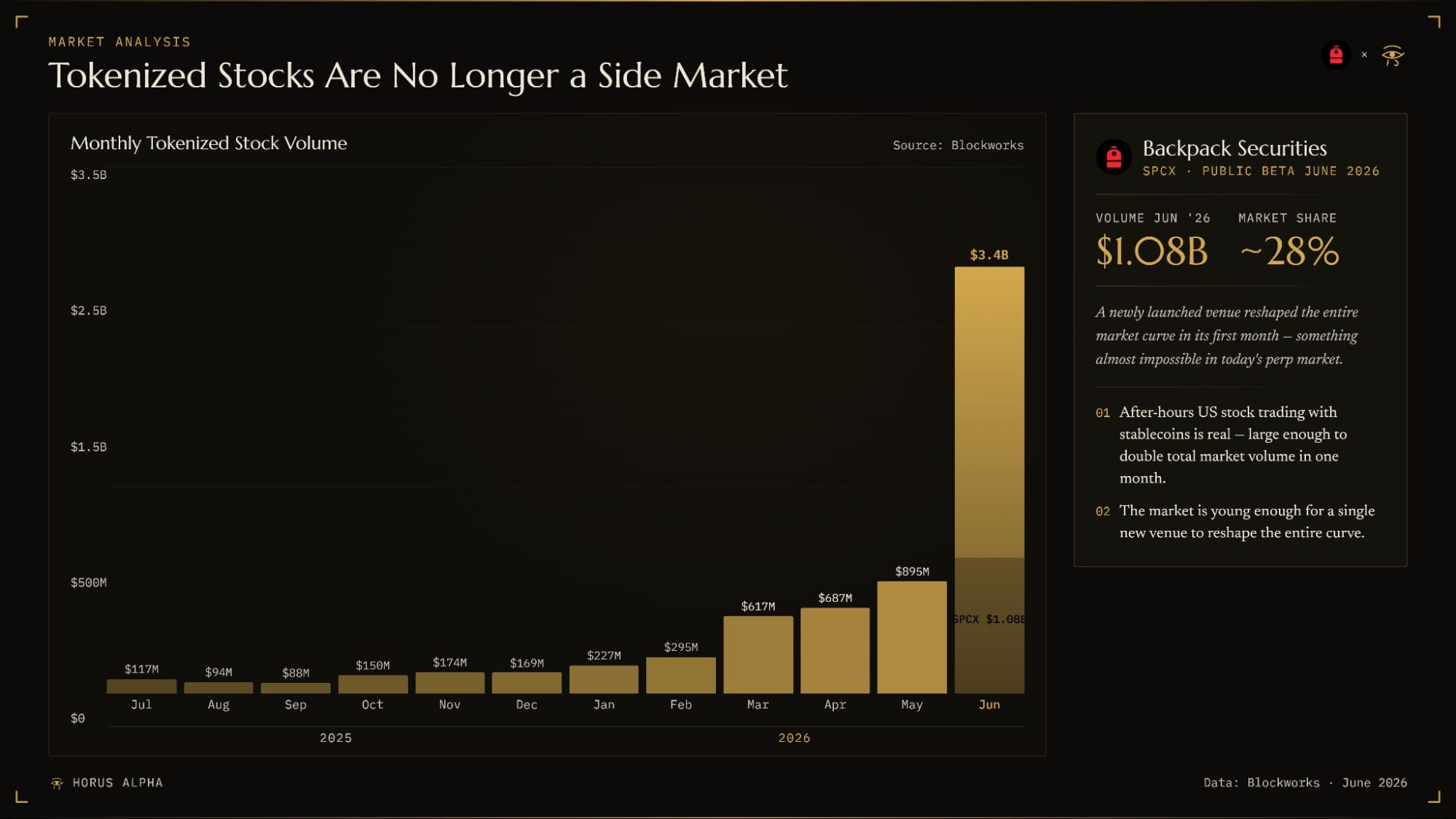
According to data from Blockworks, tokenized equities volume reached $3.4B in June 2026. SPCX, issued by Backpack Securities, contributed about $1.08B, equal to nearly 28% of the market’s total volume for the month. June was also when Backpack Securities opened its public beta.
This says two things.
- First, demand for after-hours trading of US stocks with stablecoins is real and has become large enough to more than double the market’s volume in just one month.
- Second, this market is still young enough for a newly launched venue to reshape the entire curve, something that is almost impossible in today’s perp market.
What Is Special About Backpack’s Tokenized Stocks?
The market often groups every product under the same “tokenized stock” label, even though the legal rights behind them can be very different. Two tokens can both track the price of AAPL, but one can represent rights to an asset being custodied, while the other is only a contract settled based on price movement.
Backpack offers more than a pure price exposure product. When placed next to xStocks and Ondo Global Markets, the clearest differences are the legal form of the token and the conversion path back into the brokerage system.
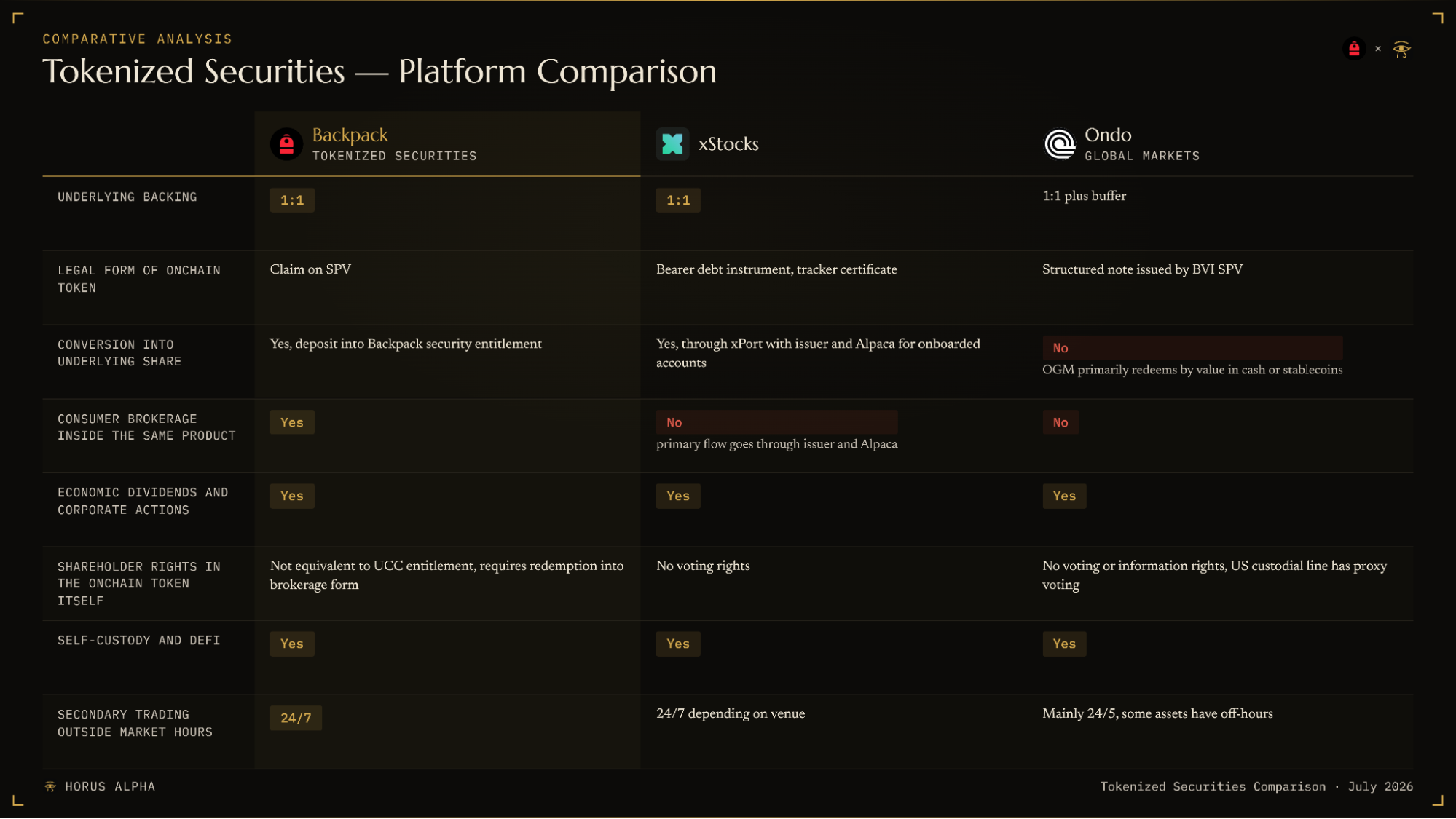
Backpack’s tokenized stocks are special because they help investors access the “price” of stocks, while also tying that access to a legal structure, ownership form, and set of economic rights.
Legal Ownership
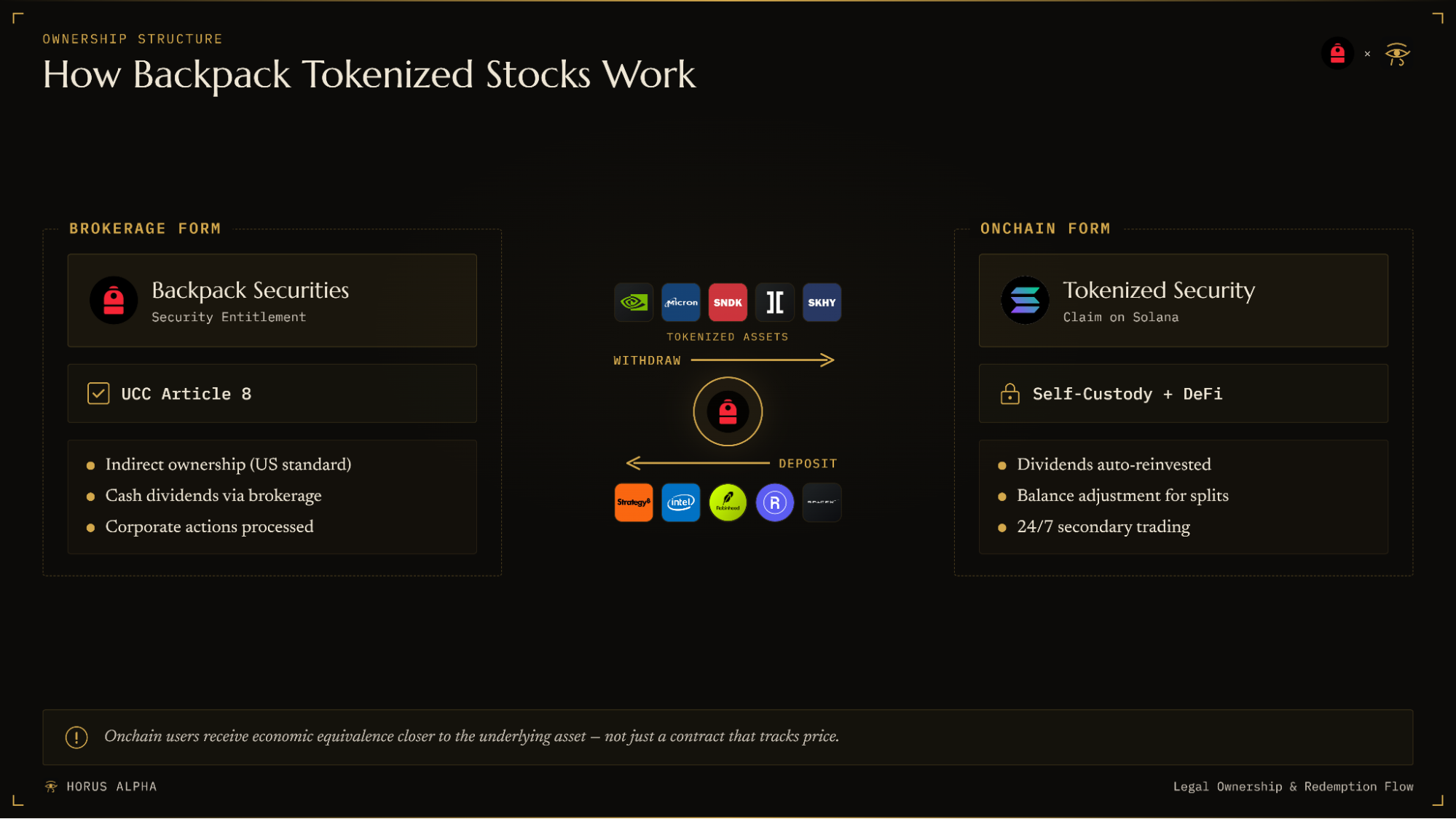
In a Backpack Securities account, users hold a security entitlement under UCC Article 8, an indirect ownership form commonly used in US brokerage accounts.
This similarity relates to ownership structure and does not extend to investor protection, operating scale, or operating history.
When the asset is brought onchain, the legal form becomes a tokenized claim. The token holder is not directly named on the shareholder register, but can deposit the token back into Backpack to receive the corresponding security entitlement.
This claim therefore has a tangible anchor into brokerage infrastructure instead of only being cash-settled when the position is closed.
Redemption and Dividends
Backpack’s tokenized stocks are designed with a two-way conversion flow.
- Users hold a security entitlement in their Backpack Securities account, then withdraw to receive a tokenized security on Solana.
- Users deposit the tokenized security back into Backpack, and the token is converted into the corresponding security entitlement.
This creates a level of flexibility that few platforms offer in the way Backpack provides it to its users.
- In the traditional form inside Backpack Securities, cash dividends and corporate actions are processed through brokerage infrastructure.
- In tokenized form, dividends are automatically reinvested into additional tokenized shares, while stock splits or applicable corporate actions are reflected through proportional balance adjustments.
Onchain users therefore receive economic equivalence that is closer to the underlying asset than a contract that only tracks price.
So Why Can Tokenized Stocks Bring More Upside to Backpack?
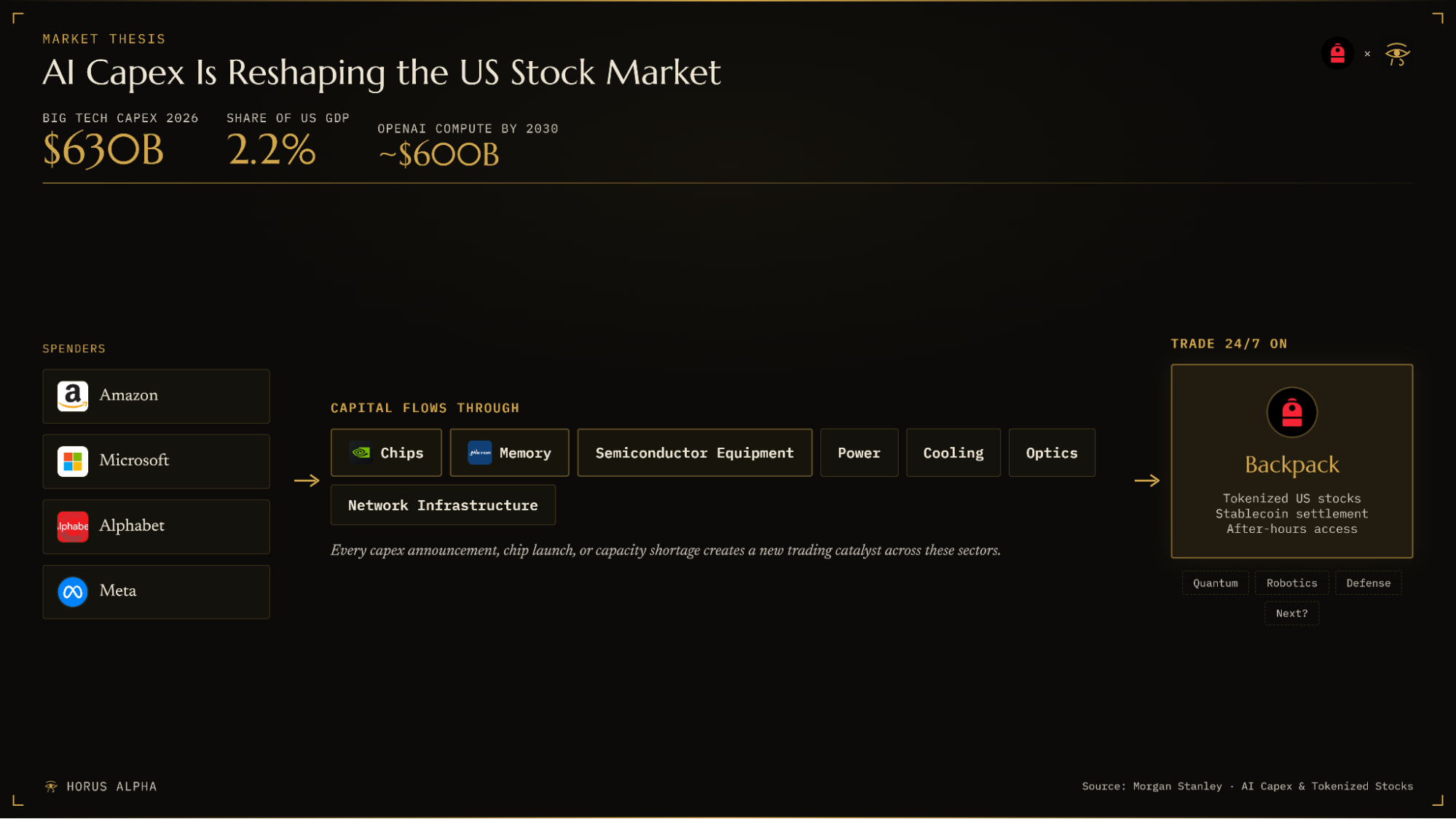
Part of the answer lies in where the market’s biggest narratives are being formed. Morgan Stanley estimates that Amazon, Microsoft, Alphabet, and Meta may spend about $630B on data centers and AI chips in 2026, equal to 2.2% of US GDP. OpenAI alone is reportedly targeting about $600B in compute costs by 2030.
These numbers do not guarantee that AI stocks will keep rising. What they show is that the technology market is entering an investment cycle large enough to continuously create catalysts for many groups of stocks. Capital flowing into data centers will move through chips, memory, semiconductor equipment, power, cooling, optics, and network infrastructure. Every time a company announces capex, launches a new chip, signs a data center contract, or reports capacity shortages, another group of stocks becomes the center of trading attention.
The narrative leading the market can change over the next few years. AI may give up some attention to quantum computing, robotics, defense tech, or an industry that has not appeared yet. What is more likely to last longer than any single narrative is the role of the US stock market in packaging and trading new technology themes. This is also the market that many international investors want to access, while the traditional brokerage experience is still not well designed for users who live on stablecoins and trade outside US market hours.
Backpack is in a fairly favorable position in front of that demand. Backpack’s flow is clear.
- USD or stablecoins enter the account.
- Users trade spot, perps, and lending.
- Users buy tokenized securities 24/7 according to the active narrative.
- Users withdraw assets to a Solana wallet if they want self-custody.
- Users deposit back to receive the corresponding security entitlement.
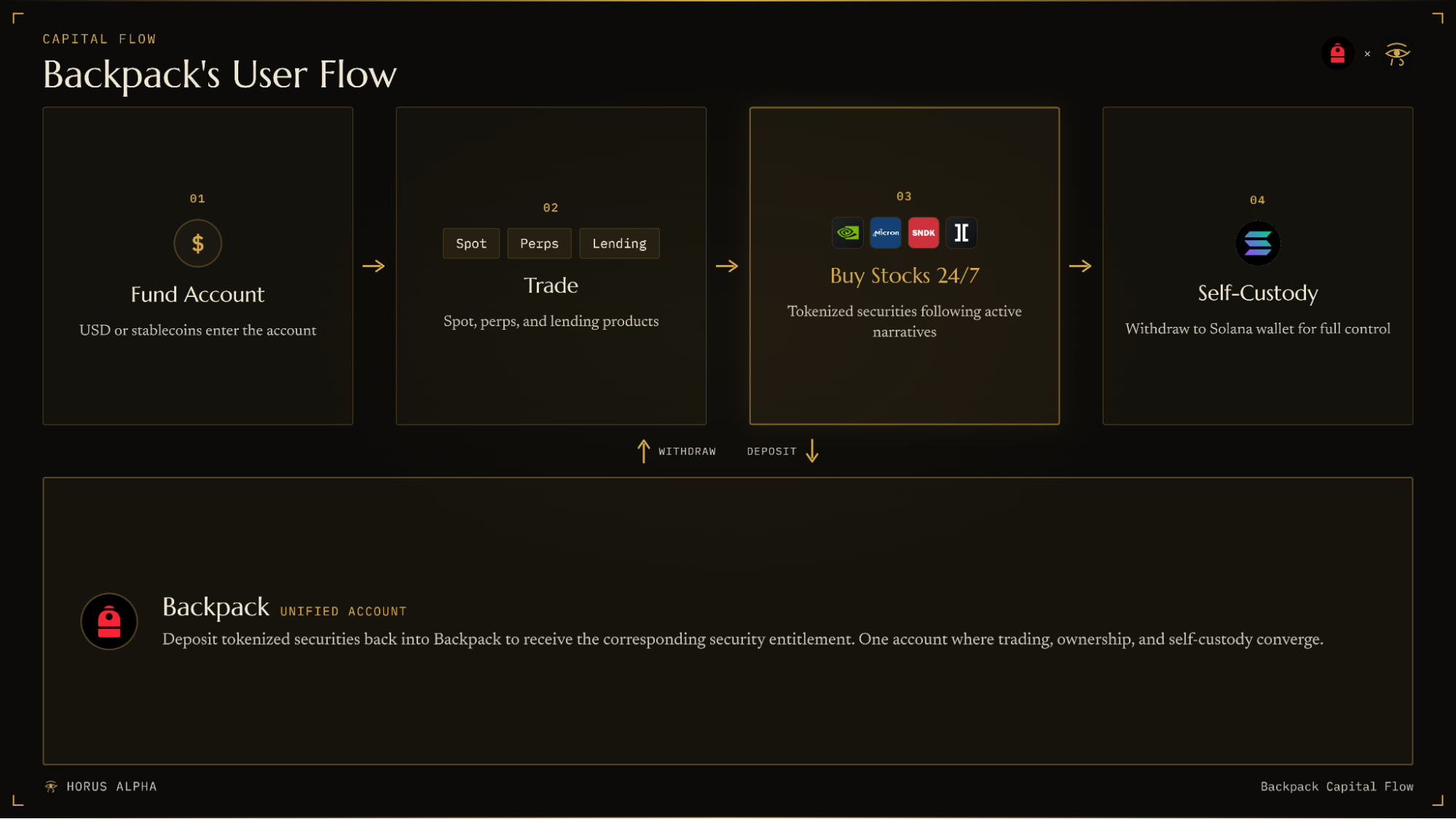
The important point is that every new narrative can become an acquisition channel. Users may arrive because they want to buy an AI or robotics stock over the weekend, but then stay because Backpack has placed spot, perps, lending, wire rails, and other financial products inside the same system.
The larger upside appears when stocks become productive capital.
At present, the utility of tokenized stocks on Backpack is still relatively thin. Users can hold, transfer to a wallet, trade on the secondary market, and redeem back into Backpack, but stocks are not yet used as collateral for other positions. The important point is that Backpack already has cross-margin, lending, and Auto Lend for crypto assets, meaning the capital system already exists. What remains is designing a way to bring securities into the collateral set in a way that fits legal, liquidity, oracle, collateral weight, and liquidation requirements.
If that happens, the Backpack account starts to operate more like a unified balance sheet. Long-term stocks can create borrowing power to borrow stablecoins, hedge with perps, or deploy capital into other products without selling the underlying asset. Users still keep exposure to the stock, but the capital sitting in the portfolio is no longer locked.
The roadmap can start with security entitlements inside Backpack Securities first, then gradually expand to tokenized claims on Solana when the onchain risk management infrastructure is mature enough. The thesis does not need both pieces to appear at the same time. As long as part of the securities portfolio is counted toward borrowing power, the user’s capital efficiency changes clearly.
If Backpack can do that inside the same unified account, capital efficiency will become a much clearer product difference than 24/7 trading, because users are not only buying stocks outside market hours, they are also using stocks as part of their working capital.
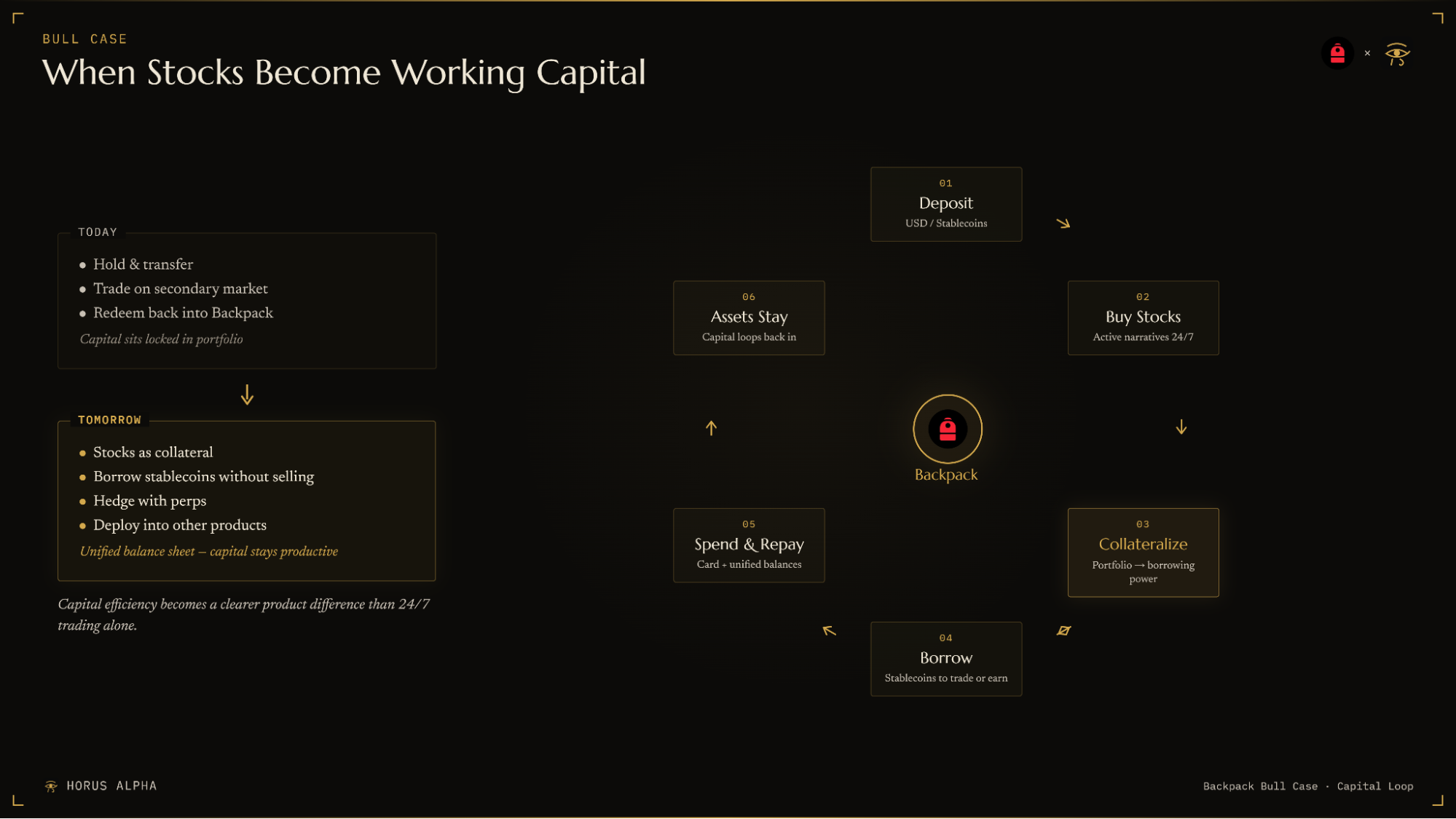
The neobank layer closes the remaining capital loop. If the card later becomes usable with unified cash or credit balances, Backpack can create a fairly complete capital flow.
Users deposit USD or stablecoins, buy stocks according to the active narrative, use the eligible portfolio as collateral, borrow stablecoins to trade or earn, then spend and repay inside the same system. That loop helps assets stay inside Backpack longer, increases the number of products each user uses, and expands revenue across each account.
Therefore, the upside of tokenized stocks is not only about adding a new market. They can turn each stock narrative into an acquisition channel, then turn the assets users hold into working capital for the entire Backpack ecosystem.
This could be one of the more ideal bull cases for Backpack.
Conclusion
Returning to the thesis at the beginning of the article, an exchange makes money from volume, and volume always comes and goes with cycles. What Backpack is building is broader than that model. This is a financial account where stocks, crypto, leverage, lending, and spending flows can coexist on one balance sheet.
Most of this loop still needs time to be proven. Stocks are not yet in the collateral set, the card is not live, and after-hours liquidity must become deep enough before securities can be safely added into margin.
Even in its current state, Backpack is already a fairly different combination of exchange and neobrokerage. If the missing pieces are implemented successfully, users who arrive because of a stock attracting attention may gradually use more products inside the same system. At that point, Backpack can move beyond the frame of a normal trading venue and become a unified financial account where assets are held longer, used more efficiently, and generate revenue across multiple product layers.
Nothing here is financial advice. Always do your own research.